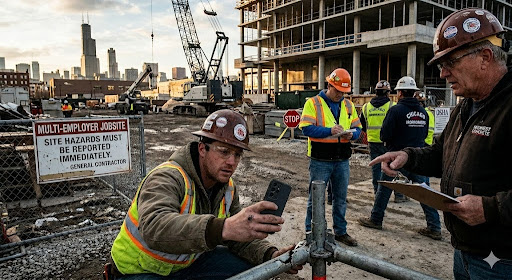

The Subcontractor Loophole That Quietly Costs Workers Thousands
Here’s the mistake I see families make in the first 48 hours after a jobsite injury: they assume someone is going to step up and take responsibility. They wait for the general contractor’s safety manager to call back. They trust that the subcontractor’s HR department will “handle it.” They believe workers’ comp will cover everything that matters.
None of those assumptions are safe ones. And the companies involved know that.
The Myths That Cost Workers Before They Even Start
Two damaging beliefs circulate after every Chicago construction injury. They’re almost opposites of each other—and both are wrong.
| The Myth | Why It Hurts You |
|---|---|
| “Workers’ comp covers everything, so there’s nothing else to pursue.” | Comp doesn’t pay for pain and suffering, long-term disability beyond the formula, or the real cost of a career-ending injury. |
| “The general contractor is automatically responsible—they run the site.” | Liability depends on control, contracts, and a paper trail most injured workers never see. |
Workers and families latch onto one or the other. Either way, they leave leverage on the table.
Workers’ compensation program basics confirm what I’ve seen firsthand: the gap between what comp pays and what a serious injury actually costs can run into hundreds of thousands of dollars. The confusion isn’t your fault—it’s baked into the structure of modern construction projects. Understanding how it actually works is the first step toward not getting buried by it.
How Liability Gets Divided on a Multi-Employer Site
Walk onto any active Chicago build—Fulton Market, the South Loop, anywhere near the lakefront—and you’re looking at a web of relationships, not a single employer.
- General contractor: manages the overall project, holds the prime contract with the developer
- Subcontractors: electricians, ironworkers, concrete crews, scaffold erectors—each with their own insurance and contracts
- Staffing companies: sometimes supply labor to one of those subs, adding yet another layer
Each layer has its own instinct to point somewhere else when someone gets hurt.
The legal question isn’t just who employed the injured worker. It’s who had control over the hazard that caused the injury. That’s a different question entirely—and it’s the one that opens or closes the door to a personal injury lawsuit beyond workers’ comp.
Under OSHA’s multi-employer citation policy, both a general contractor and a subcontractor can be cited on the same site for the same violation. OSHA doesn’t care whose employee got hurt. It cares who created the hazard, who controlled the area, who had the authority to fix it. That same logic carries into civil liability. If the general contractor had supervisory authority over the scaffold that failed, their “we didn’t employ him” defense gets considerably weaker.
The federal construction safety standards under 29 CFR 1926 require employers to maintain a workplace free from recognized hazards—and “employer” in that context isn’t limited to the company that cuts your paycheck. Courts in Illinois have leaned on this when determining whether a general contractor owed a duty of care to a subcontractor’s employee.
So when the GC’s rep tells you “that’s the sub’s problem,” what they’re really communicating is their opening position in a negotiation you didn’t know you were in.
Workers’ Comp vs. a Personal Injury Lawsuit
This is the comparison that matters most. It’s also the one most workers never get explained clearly.
Workers’ compensation is a no-fault system. You don’t have to prove anyone was negligent—you file, you get medical coverage and a portion of lost wages, and in exchange, you generally can’t sue your direct employer. It moves fast and avoids courtrooms. The catch, as reflected in the federal wage and compensation framework: comp doesn’t pay for pain and suffering, and it doesn’t pay for what you lost beyond the wage formula. For a fall from height, a trench collapse, or a struck-by incident, that gap can mean hundreds of thousands of dollars.
A personal injury lawsuit requires proving negligence—but it can recover full damages: pain and suffering, future lost earnings, loss of quality of life. The critical piece is that the immunity workers’ comp gives your direct employer doesn’t extend to third parties. If you’re a sub’s employee and the general contractor’s negligence contributed to your injury, you may be able to sue the GC. If a separate sub created the hazard, you may have a claim against them too.
Here’s the counterintuitive part: the multi-employer structure, which usually feels like it’s working against you, can actually create options. More parties potentially means more insurance policies, more exposure, and more pressure to settle fairly. But only if someone maps the liability chain before the evidence disappears.
If you’re navigating this and want a sense of how these claims get built, talking to a boston construction site injury lawyer who handles multi-party construction cases can help you understand what questions to ask—even if your case is elsewhere.
The First 72 Hours: What’s Happening While You’re Still in the Hospital
The pattern is almost predictable.
Within hours of a serious injury, the general contractor’s safety team is on site documenting the scene—from their perspective. The subcontractor’s foreman is on the phone with their insurance adjuster. The staffing company, if one’s involved, is pulling the worker’s file and reviewing how they classified the employment relationship. Everyone is building their version of events before you’ve even been discharged.
The injured worker, meanwhile, is dealing with pain, fear, and a phone full of calls they don’t know how to answer. That asymmetry is not an accident.
What to gather in those first 72 hours:
- Photographs of the scene before anything is moved or repaired
- Names and contact information of every witness
- A written copy of the incident report—don’t accept verbal summaries
- Safety meeting logs and toolbox talk records
- The contract between the general contractor and the subcontractor
That last document is the one most workers never think to ask for. It’s often where the real story lives. The contract will tell you whether the sub was required to carry specific insurance limits, whether there’s an indemnity agreement shifting liability between parties, and whether the sub was required to name the GC as an additional insured on their insurance policy. All of that determines who actually pays when a claim is filed—regardless of who caused the injury.
The Objections You’ll Hear—Decoded
“He was an independent contractor, not our employee.”
This comes up constantly with smaller subs and staffing arrangements. The Department of Labor’s 2024 final rule restored a multi-factor economic reality test for determining contractor status—meaning the label on the contract isn’t the end of the analysis. If the company controlled how the work was done, set the schedule, provided the tools, and directed the worker on site, a court may find employment regardless of what the paperwork says.
“Our insurance doesn’t cover that—it’s the sub’s responsibility.”
Maybe. But if the general contractor required the sub to carry insurance and the sub let it lapse, the GC may have exposure for failing to verify coverage. Confirming that subs are properly insured isn’t just self-protection—it’s part of responsible site management.
“You already filed workers’ comp, so you can’t sue anyone.”
Filing a workers’ comp claim doesn’t waive your right to pursue third-party claims. It limits your claims against your direct employer. Everyone else on that site is still potentially in play.
“There’s no way to prove who was responsible.”
This is where the paper trail matters. Subcontractor agreements, safety inspection logs, OSHA records, incident reports, and insurance certificates all tell a story. The question is whether someone is pulling them together fast enough.
A Practical Starting Point
You don’t need to have everything figured out. You need to start gathering before things disappear.
Five things you can do right now:
- Get the incident report in writing—no verbal summaries
- Photograph everything accessible: the scene, the equipment, any visible hazards
- Write down every company name you saw on that site (trucks, hard hats, signage)
- Ask your union rep, if you have one, to help identify who held the prime contract
- Don’t sign anything from any insurance adjuster without talking to an attorney first
The indemnity agreement and insurance policy language buried in the subcontracts will shape how liability gets allocated. You won’t have access to those documents immediately—an attorney can request them through discovery. What you can control right now is preserving your own account and not letting anyone else’s version of events go unchallenged.
Where to Learn More
The OSHA construction standards are publicly available and searchable if you want to understand what safety requirements applied to your specific type of work. Your state’s workers’ compensation board will have information on filing deadlines.
And if you’re trying to understand whether a third-party claim exists alongside your comp case—a construction injury attorney who handles multi-employer sites specifically, not just general personal injury, is the right conversation to have. The liability chain on these cases is specific enough that general experience doesn’t always cut it.
You’re not crazy for thinking the answers you’re getting don’t add up. They often don’t—because the people giving them have their own interests in how the story ends.
