
You Have Two Years to File and Thirty Seconds to Say the Wrong Thing to an Adjuster
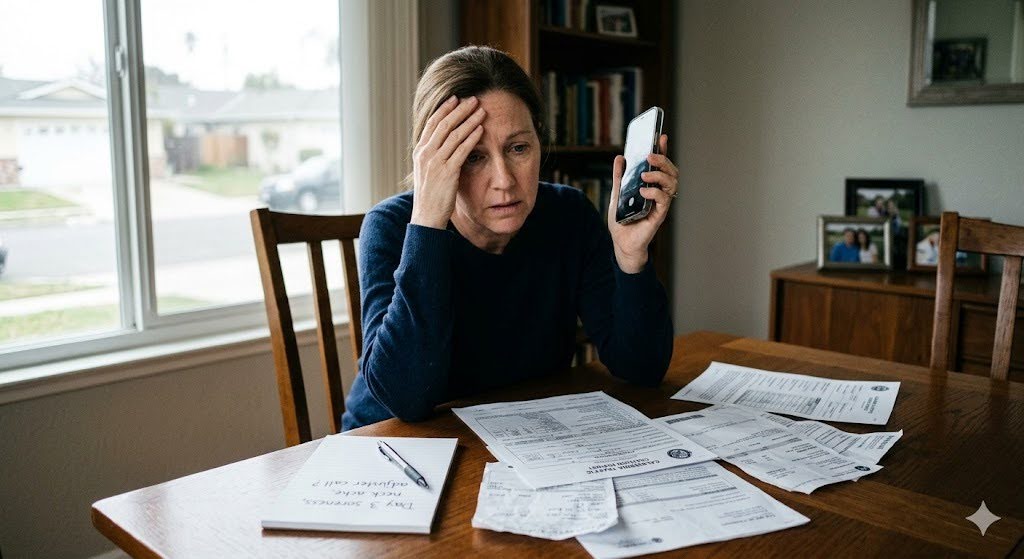
Picture this: it’s the third day after your car accident. You’re stiff, your neck aches in a way that wasn’t there yesterday, and your phone has rung twice from an unknown number you’re pretty sure is the other driver’s insurance company. You haven’t called anyone yet because you’re not sure you should—maybe the soreness will pass, maybe it’s not serious enough to make a fuss over, maybe you’ll sound dramatic.
That hesitation is where most California drivers quietly lose ground they can never get back.
Not because they did anything wrong. Because nobody told them what to do next, calmly and in order. That’s what I want to do here.
The Claim Process, Step by Step
A personal injury claim is a formal request for compensation from the party responsible for your injuries. It can be resolved through an insurance settlement or, if necessary, a lawsuit. Most people never see a courtroom—but the steps you take in the first days and weeks determine how strong your position is if it ever comes to that.
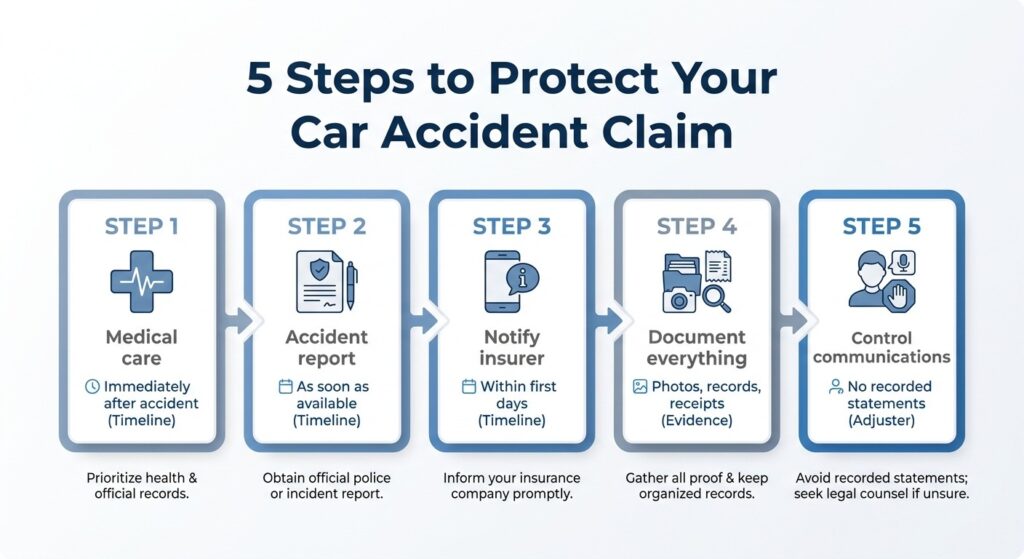
| Step | Action | Why It Matters |
|---|---|---|
| 1 | Get medical care immediately | Delays give insurers grounds to dispute your injuries |
| 2 | Obtain the accident report | Establishes facts, parties, and preliminary fault |
| 3 | Notify your own insurer | Required by your policy; different from giving a statement |
| 4 | Build your documentation file | Creates the evidentiary foundation for your claim |
| 5 | Control adjuster communications | Prevents minimizing statements from entering the record |
Step one is medical care, and it cannot wait. I know that sounds obvious, but I watch people talk themselves out of it constantly. They think, it’s just soreness, I’ll see how I feel Monday. The problem is that delaying treatment gives insurers a clean argument: if you were really hurt, you would have gone to the doctor. That gap in your timeline becomes a gap in your medical records, and that gap becomes a reason to reduce or deny your claim. Go. Even if it turns out to be minor, go.
Step two is the accident report. If police responded to the scene, a report was filed—get a copy as soon as it’s available through the responding agency. If no report was filed, you may still be able to file one yourself through the California DMV (required when damages exceed $1,000 or there are injuries). The accident report establishes the basic facts: date, location, parties involved, and often a preliminary fault determination. It’s not the final word on liability, but it’s the foundation everything else is built on.
Steps three through five unfold in parallel rather than sequence. Notify your insurer promptly, start building your documentation file, and be deliberate about every word you say to any adjuster. Each of those tracks runs simultaneously from day one.
The Deadlines That Actually Matter
California’s statute of limitations for personal injury claims is two years from the date of injury. Two years sounds like a long time. It isn’t, once you factor in medical treatment, recovery, gathering records, and finding the right legal help.
There’s a critical exception most people don’t know about.
If the at-fault driver was a government employee operating a government vehicle—a city bus, a county truck, a public works van—your window to file a government tort claim can be as short as six months. That’s not a typo. So the first thing I want you to do is identify who you’re dealing with:
- Private driver: Two years from the date of injury
- Government entity: As little as six months—start counting immediately and talk to someone now
Beyond the lawsuit deadline, there are softer timelines that matter just as much in practice. Surveillance footage gets overwritten. Witnesses’ memories fade. Skid marks disappear. The sooner you begin documenting and preserving, the stronger your position. This isn’t about being aggressive—it’s about being smart before the window closes naturally.
One more timing note that surprises people: your own underinsured or uninsured motorist coverage has its own claim deadlines, often buried in your policy. If the other driver had minimal or no insurance, your own policy may be your primary source of compensation—but only if you notify your insurer within the required timeframe.
What to Document and How to Keep It
The core evidence in a personal injury case includes photos of the scene or injuries, medical bills or doctor reports, witness statements, and police reports. Let me make that practical.
Photos and video. Take them at the scene if you can, and continue photographing injuries as they develop over the following days. Bruising and swelling often peak 48–72 hours after impact. A photo from day three can be more compelling than one taken at the scene.
Medical records. Every visit, every provider, every prescription. Request copies proactively—don’t assume your attorney or insurer will gather them for you. Keep a simple running log of your symptoms, how they affect your daily life, sleep, work, and activities. This personal record becomes powerful when you’re trying to demonstrate pain and suffering later.
Witness information. Names and phone numbers collected at the scene. A written statement from a witness, even a brief one, can corroborate your account when memories are fresh.
Your own notes. Write down what happened while it’s clear—what you saw, what was said, road conditions, weather, the sequence of events. Date your notes. These aren’t legally binding documents. They’re memory anchors that help you stay consistent months later when details blur.
Quick checklist: Accident photos → Injury photos (days 1, 3, 7) → Medical records → Witness names → Repair estimates → Rental receipts → Personal symptom log → Written account of events
Save everything. Vehicle damage is economic loss. So are rental car costs, transportation to medical appointments, and any out-of-pocket expenses tied to the accident.
Talking to the Insurance Adjuster
This is where I see the most preventable damage, and it almost always comes from people trying to be cooperative and polite.
An insurance adjuster—even one from your own company—is trained to evaluate claims efficiently, which means finding reasons to limit payouts. That’s not cynicism; it’s just how the system works. Knowing that going in changes how you approach every conversation.
What to Say vs. What to Avoid
Do not give a recorded statement to the other driver’s insurer without legal guidance. They will ask. They may imply it’s required. It isn’t—not to the adverse insurer. Recorded statements taken in the first days after an accident often capture people who are still shaken, still uncertain about their injuries, and still trying to be helpful. Adjusters are skilled at asking questions that elicit minimizing answers: “So you’re feeling okay today?” If you say yes because you’re being polite, that answer lives in the record.
What you can and should do instead:
- Confirm basic facts (date, location, that an accident occurred)
- State that you are still being evaluated medically
- Say your attorney will be in touch—or that you’ll follow up once you’ve reviewed the situation
- End the call
You don’t have to be rude. You just have to be careful.
With your own insurer, the dynamic is slightly different. You do have a duty to cooperate under your policy—but “cooperate” doesn’t mean accepting a fast settlement before you know the full extent of your injuries. It means providing accurate information. If an adjuster pushes for a quick resolution, it’s almost always because early settlements are cheaper for them, not because it’s better for you.
“But Is My Injury Even Serious Enough?”
This is the question I hear most. It’s also the one that holds people back the longest.
The honest answer: you often don’t know yet, and that uncertainty is exactly why you need to document and not wait. Soft tissue injuries—whiplash, muscle strain, nerve irritation—can take weeks to fully manifest. What feels like manageable soreness on day two can become a chronic condition that affects your ability to work and sleep for months.
The legal system doesn’t require broken bones. It requires that you were injured as a result of someone else’s negligence, and that you have documentation to support it.
If you already spoke to an adjuster and said something you’re worried about—“I’m fine,” “it wasn’t that bad,” “I don’t think I need to go to the hospital”—take a breath. Those statements can be addressed. They’re not automatically fatal to your claim. What matters now is what you do going forward.
The Two Categories of Compensation
| Type | What It Covers | Examples |
|---|---|---|
| Economic damages | Concrete, calculable losses | Medical bills, lost wages, future treatment, property damage |
| Non-economic damages | Subjective impact on your life | Pain and suffering, emotional distress, loss of enjoyment |
Both are legitimate. Both require documentation to support. If the case involves particularly egregious conduct by the at-fault party, California court forms even provide a specific attachment for seeking punitive damages—though that’s a conversation for an attorney.
When a Personal Injury Lawyer Actually Helps
Most personal injury attorneys in California work on contingency—no upfront cost, they take a percentage if you recover. A consultation costs you nothing, and it often clarifies your situation faster than weeks of anxious research.
Here’s a straightforward way to think about it: the more complicated your situation, the more a lawyer shifts the odds in your favor.
A lawyer becomes especially useful when:
- Your injuries are more than minor
- Liability is disputed
- The other driver was uninsured or underinsured
- A government entity is involved
- An insurer is pressuring you toward a fast settlement
Even a single consultation—before you sign anything or give any recorded statement—can reframe your entire approach. If you’re outside California, the same principle applies: a personal injury attorney ma operates under different state deadlines and rules, which is exactly why jurisdiction-specific guidance matters.
The evidence standards California courts apply to personal injury cases are specific, and an experienced attorney knows how to build toward them from day one. Most cases settle without going to trial, but the strength of your settlement offer is almost always a function of how well-documented your claim is from the start.
Where to Focus Right Now
If you’re in the early days after an accident, cut through the noise and concentrate on five things:
- Get medical care and keep every record
- Obtain the accident report
- Photograph everything—scene, vehicle, injuries, and injuries again on day three
- Write down your account of events while it’s fresh
- Do not give a recorded statement to the adverse insurer before speaking to someone who can advise you
You’re not being paranoid. You’re not being litigious. The insurance system is built on documentation and timelines, and the people on the other side of your claim understand that better than most injured drivers do.
Protecting yourself simply means learning the rules of a game that’s already started. You have options, and small careful steps taken now are what keep those options open.
